

Some people’s career paths read like a straight line. Eric Levine’s reads more like a philosophical argument — and that, it turns out, is exactly the point.
Eric spent years operating as a world-class strategist inside two of the most recognizable companies of the modern era, working under two of the most trailblazing founders of our time. He wasn’t just along for the ride. At Meta, he was the person authoring the strategy on how Facebook and Instagram would take on TikTok — then executing that strategy globally. That’s the kind of work that defines careers. And yet, at the height of it, he walked away without a plan.
That decision — and everything that followed — is what this episode is really about.
The Long Way Around
Before any of that, there was a philosophy student at the University of Michigan who had deliberately tanked his business school application.
Eric arrived at college as what he describes as an “extremely tunnel-visioned, mathematical, linear thinker.” Math was his world. One right answer to everything. But he didn’t want business school at 18 — he wanted to actually learn something, to break out of his own boundaries. So he found philosophy, and it rewired him.
What philosophy gave him wasn’t just a different subject. It gave him a framework for thinking: take a complex, ambiguous problem, break it into logical steps, test every assumption, argue the validity of each piece. Strip away what’s irrelevant. Structure what remains into a convincing argument. If that sounds a lot like strategy consulting — that’s the whole thread.
But the world doesn’t hand jobs to philosophy majors. So Eric did what he needed to do: a master’s in accounting at UNC (a program specifically built for liberal arts grads), three years in public accounting at Deloitte, and then — when he found himself completely pigeonholed — business school at UCLA Anderson. He knew from day one of his accounting program that he didn’t want to do accounting. He did four years of it anyway, using it as the platform to eventually get somewhere else.
Meta, TikTok, and Learning to Think Globally
The pivot point came at Hyperloop, where an FP&A role gradually evolved into something with real strategic teeth. That experience bought him enough credibility to land at Meta in a strategy and operations role focused on Facebook’s entertainment partnerships — working with celebrities and creators in LA.
Then TikTok happened.
Two years into his time at Meta, TikTok was eating their lunch in a way that couldn’t be ignored. Eric was tapped to author the competitive strategy for how Facebook and Instagram would respond — specifically for the creator ecosystem. Once it cleared the C-suite, he spent the next two years executing it globally. It’s a remarkable thing to have on your career ledger, and it deepened a skill that would later become the foundation of his own company.
But there’s a ceiling to that kind of work. After a few years running the same strategic playbook, even a fascinating one, it becomes repeatable. Predictable. Eric needed a new problem. He looked around the company, didn’t find one that lit him up, and made a decision that he describes as one of the scariest things he’s ever done.
He quit. No job lined up. No plan.
The Pause
This is the part of the episode that stuck with me most — the section that doesn’t show up on a LinkedIn profile.
After leaving Meta, Eric spent months decompressing, sitting on the beach in Venice, genuinely figuring out what came next. He’d spent 15 years grinding toward the C-suite and suddenly the corporate ladder felt not like a climb but like a cage. The quality of life on the other side — the non-traditional schedule, the autonomy, the actual breathing room — made going back feel viscerally wrong every time he considered it.
Out of that pause came a hobby project: ScubaZen, a dive log app he built almost entirely through AI-assisted coding and YouTube tutorials. He knew nothing about software engineering. He built it anyway. It never made a dollar, and that wasn’t really the point — it proved he could go from concept to market without a technical co-founder, which turned out to be the more important lesson.
A second app followed, failed faster, and closed. But something had shifted.
StratEngine AI: The Idea That Actually Had Legs
The insight that led to StratEngine came from a simple question Eric started asking himself: what would I have actually wanted at Meta to make my job easier and faster?
Strategy work is enormously labor-intensive. Research, frameworks, analysis, stakeholder decks, implementation planning — it’s weeks of output that often requires entire teams. Eric had spent years doing this at the highest level, and he could see exactly where AI could compress the timeline without compressing the quality.
StratEngine AI is built around that insight. You enter the business problem. The platform does the research, applies the frameworks, produces the full analysis, and generates the implementation plan — along with the decks and documents to go with it. It’s built primarily for strategy consultants, but the use cases extend to executives at companies of any size.
What makes this interesting isn’t just the product — it’s the position Eric can occupy in the market. He’s not a software engineer who learned strategy. He’s a world-class strategist who learned to build software. In an industry where most founders come from one side or the other, that combination is genuinely rare. And in a space where, as he puts it, “nobody really knows anything,” that practical strategic fluency might be the sharpest edge he has.
Eric’s Flip Story Recipe
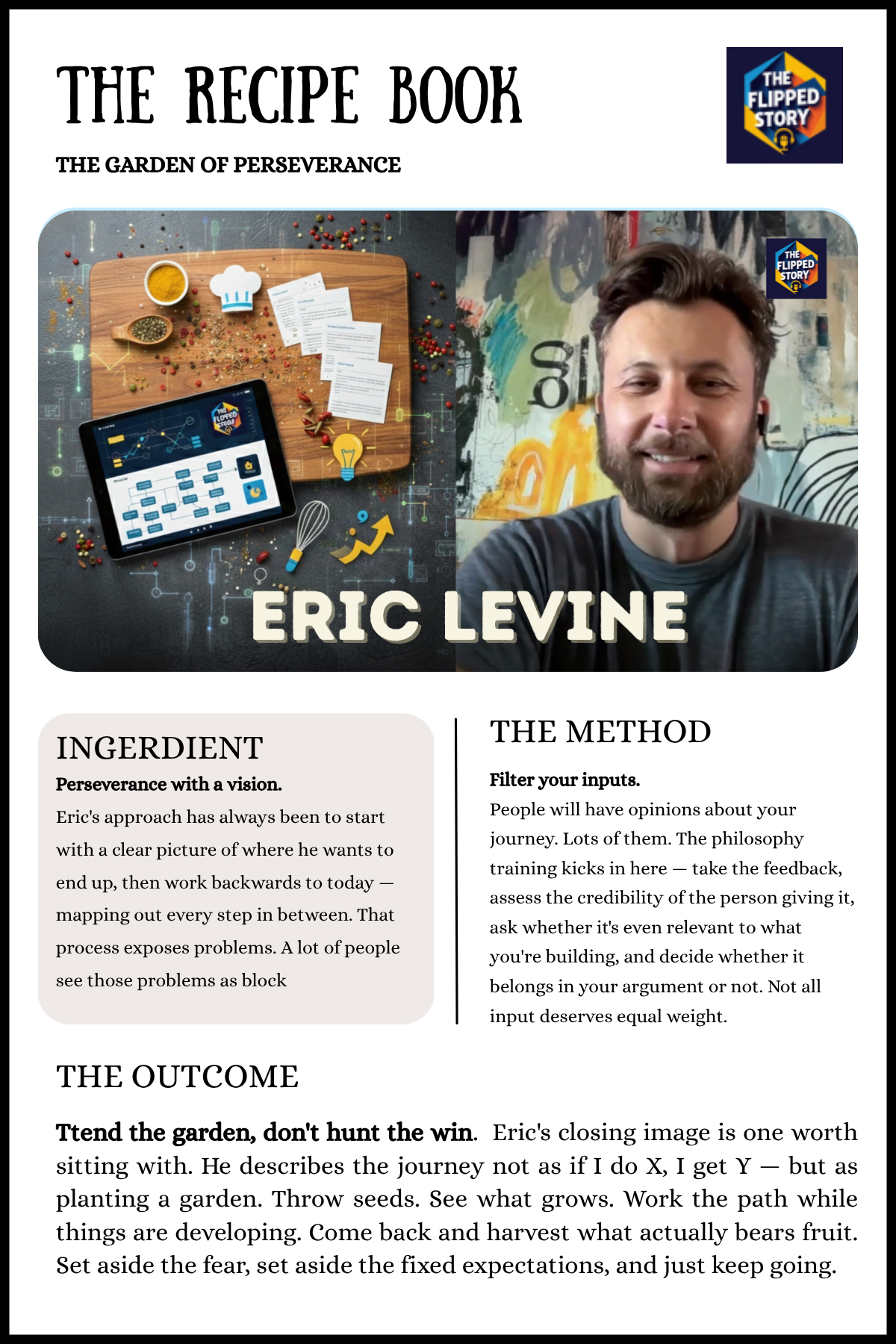
Every episode closes with what we call the Flip Story Recipe Book — an invitation for guests to leave the audience with something they can actually use. A key ingredient, a method, an outcome. Here’s Eric’s:
Worth Watching
What I took from this episode is a story about intellectual honesty — about someone who kept refusing to pretend that the comfortable path was the right one. From bombing a business school application on purpose, to grinding through years of accounting he didn’t want to do, to walking away from one of the best strategy jobs in tech with nowhere to go, Eric has consistently been willing to sit with uncertainty long enough to find what’s actually worth doing.
The philosophy background wasn’t a detour. It was the whole engine.
The episode is worth your time, especially if you’re somewhere in the middle of your own uncomfortable pause — the place between what you’ve been and what you might become.
Find Eric at stratengineai.com or reach him at eric@stratengineai.com.
Catch the full episode on your favorite podcast streamer


