

Most of us spend our lives following a script. We have one for our meetings, one for our sales calls, and now — thanks to AI — we even have scripts for our “authentic” interactions. But Kat Koppett has spent her career making the case that the script is the problem.
Kat is one of the founding voices in the field of applied improv — the practice of bringing improvisation principles into organizational life to build the skills that actually drive performance: listening, psychological safety, adaptability, creativity under pressure. Her book Training to Imagine is now in its third edition, 25 years after she wrote it at the forefront of a field that barely had a name. She has worked with Apple, NASA, and the United Nations. She also owns an improv theater in a converted firehouse in Schenectady, New York.
I’m genuinely glad she said yes to this one.
The Origin Story Nobody Plans For
Kat’s path from NYU drama school to building a global consultancy is one of those stories that only makes sense in reverse — a series of unexpected offers, each one accepted, each one leading somewhere the previous step couldn’t have predicted. There’s a struggling actor phase, a day job teaching English to Soviet refugees, a pivotal workshop with an improv instructor, and a trip back to Columbia for a master’s in organizational psychology — just to make sure she wasn’t selling snake oil.
The full version is worth your time, and you’ll want to tune into the episode to catch it. But the short version is this: people were starving for the things improvisers take for granted — being seen, heard, invited to express themselves, and allowed to connect. Kat saw it early, built the framework to prove it, and spent the next 25 years taking it to organizations around the world.
The Reseach Around Play That Show the Benefits of Improv
The part of this conversation that I found most compelling was Kat’s explanation of how applied improv actually connects to the research — because skeptics (reasonably) want to know: is this real, or is it a clever workshop that feels good and disappears Monday morning?
The short answer: the connections are well-established, even if the term “improv” doesn’t always show up in the footnotes.
Amy Edmondson’s work on psychological safety — one of the most cited findings in organizational behavior — shows that teams who feel safe enough to take risks, admit mistakes, and investigate failures outperform teams that don’t. The research is clear. But the follow-up question most organizations can’t answer is: how do you actually build that safety? How do you train the muscle of being willing to fail visibly and move forward?
That’s exactly what improv practice is designed to do.
Same with listening. Everyone agrees it’s critical. But most leadership development programs treat it like a reminder: listen more, be present. Improvisers have developed specific exercises, built over decades of performance, to actually train that capacity — because in improv, if you don’t listen, the scene dies. The stakes are immediate and real.
Idea generation, presence, storytelling, trust-building — the research on each of these has grown enormously. Improv turns out to be a gym for all of it.
A Second Flip! Buying the Firehouse
Here’s where the story takes a turn that I think matters more than it might appear on the surface.
About nine years ago, Kat and her husband looked at a hundred-year-old firehouse in upstate New York — one that had, somewhere in its past, been the subject of a Jerry Springer episode — and decided to turn it into an improv theater. Their financial advisor was direct about it: they could have the theater or they could have a retirement. Maybe not both.
They bought the firehouse.
For most of her career, Kat had quietly thought of the organizational consulting as the real work, and the improv theater as the passion project on the side. MOPCO — the theater company — was something she loved, but it wasn’t the serious part of the business.
Then COVID happened. MOPCO went dark for a year and a half. And when live performance came back, something had shifted in how people were showing up.
What returned first wasn’t the shows — it was the classes. Specifically, a drop-in class format that asked nothing of participants except to come, play, and be in the same space with other people. No performance pressure, no commitment to a series. Just a place to exist together. It caught fire. People came every week, made it their community, and kept coming — not to become improvisers, but because they were hungry for something they couldn’t quite name.
That’s when Kat stopped thinking of the theater as a side project.
The Modern Age Problem (and Why Improv Is the Answer)
There’s a phrase Kat uses that I keep coming back to: the OG AI — authentic interaction.
She’s been watching the same thing most of us are watching: teams that can’t have difficult conversations, professionals who avoid in-person interaction, a general atrophying of the muscles we use to be present with each other. The capacity to show up — to make eye contact, to speak in a room, to connect with a colleague without a script — is increasingly what sets people apart.
The irony she names is uncomfortable but important: at exactly the moment when the world is most uncertain and change is most rapid — when resilience, adaptability, and creative problem-solving matter most — organizations are pulling back from the conditions that build those things. Risk feels more dangerous when we’re already scared. So we say no more. We protect the quarter. We hand more tasks to AI and practice connection less.
Kat quotes Keith Johnstone: There are people who prefer to say yes and people who prefer to say no. People who say no are rewarded by the safety they attain, and people who say yes are rewarded by the adventures they have.
The point isn’t that yes is always right. It’s that if you want to move forward and grow and adapt, a yes-and mindset is the only one that gets you there. And like any other capacity, it’s something you can actually practice.
A mechanical engineer once told Kat that the strongest part of any system is the most flexible. Rigidity breaks. Flexibility holds.
Kat’s Flip Story Recipe
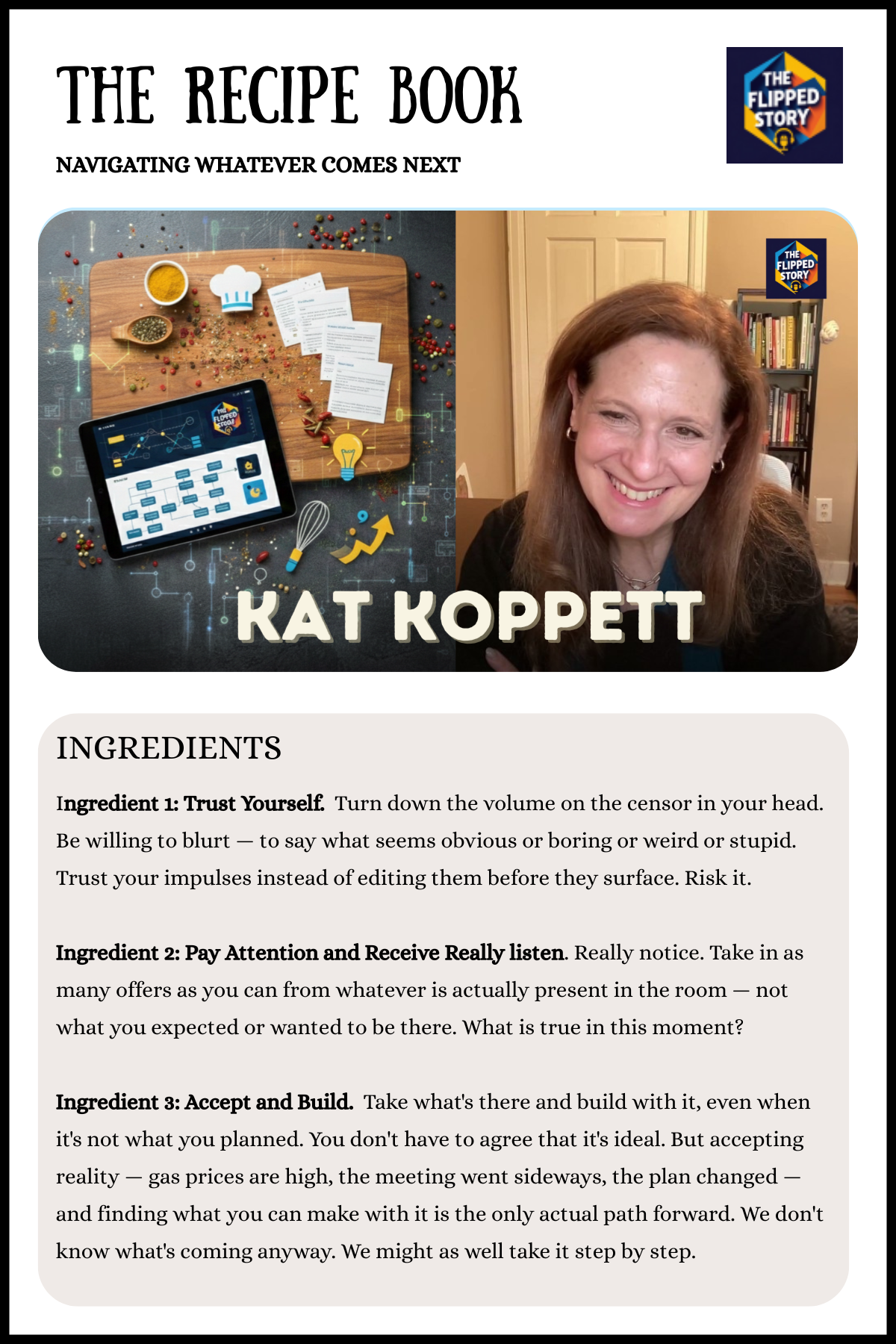
Every episode of The Flipped Story closes with what we call the Flip Story Recipe Book — an invitation for guests to leave you with something practical. Here’s Kat’s recipe for successfully navigating the scenes of life, drawn from decades of applied improv practice:
Worth Watching
What stayed with me from this conversation is Kat’s insistence that the skills people most need right now — to listen, to take a risk, to connect, to be present — are not fixed traits you either have or don’t. They’re muscles. They atrophy when you don’t use them. They grow when you practice.
We are outsourcing more of our communication, our thinking, and our connection every year. Kat’s argument isn’t anti-technology — she’s clear about that. The question is where technology expands our capacity and where it substitutes for it. The cost of substituting for human connection, she says, is that we lose the whole point of it all.
That might be the most important thing she said. And she said it without a script.
Find Kat at koppett.com or follow her work at mopco.org — and if you’re anywhere near Schenectady, go to a show!
Catch the full episode on your favorite podcast streamer.


